
 By
By 
The word “luxury” has been applied so liberally in Bangalore’s interior design market that it has become almost meaningless. It appears in the marketing of firms at every price point – from ₹800 per square foot packages to ₹6,000 per square foot bespoke commissions. The word signals nothing reliable about quality.
Genuine luxury is rarer – and far more specific. The luxury interior designers in Bangalore who actually operate at this level are distinguished not by what they say about themselves but by observable, verifiable characteristics – the quality of materials they specify, the precision of their execution, the coherence of their design thinking, and the substance of their warranty commitments.
This guide examines what genuine luxury interior design means in a Bangalore context – and which firms consistently deliver it.
H2: What Genuine Luxury Interior Design Actually Means
Luxury in interior design is not primarily about price. It is about the accumulation of considered decisions – at every scale, from the architecture of the space to the weight of the door handles – that produce an environment of unmistakable quality.
The characteristics of genuine luxury interior design:
Material authenticity Luxury interiors use genuine materials – Italian marble, solid hardwood, hand-knotted rugs, handblown glass – rather than surface treatments that simulate these materials. The difference is immediately apparent in person even if photographs can obscure it.
Craft quality in execution The gap between a luxury interior and a premium-looking one is most visible in the finish quality – the precision of joinery, the straightness of a tiled wall, the consistency of a paint finish across surfaces. These details require craftsmen with genuine skill and supervisors who hold high standards on site every day.
Design coherence A luxury interior has a coherent design logic that runs from the overall spatial concept through material selection, furniture design, lighting design, and accessory placement. Nothing is arbitrary. Nothing is left to the last minute. The best luxury designers develop this coherence through extensive pre-execution design work – not through improvisation on site.
Restraint over excess Genuine luxury is almost always characterised by restraint – by what the designer chose not to do as much as by what they chose to include. The instinct to fill every surface, use every technique, and select the most visually complex option at every turn produces interiors that are impressive but uncomfortable. The best luxury designers understand when to stop.
H2: The Luxury Interior Design Landscape in Bangalore
Bangalore has developed a genuine luxury residential market over the past decade – driven by the concentration of senior technology executives, successful entrepreneurs, and NRI families investing in the city’s premium residential developments.
This has created demand for interior designers who can match the material quality, design sophistication, and execution standards that this clientele has encountered in Singapore, London, Dubai, and New York. The firms that have risen to meet this demand are those with genuine design depth, strong vendor relationships, experienced project teams, and portfolios of completed projects that stand up to international comparison.
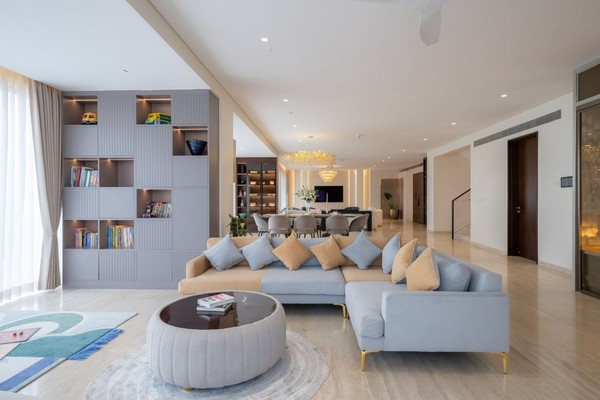
The KariGhars is among the most established of these firms – having built a 15-year track record of luxury residential delivery across Bangalore’s most premium developments. Their projects span HSR Layout villas, Koramangala penthouses, Whitefield independent homes, and high-specification apartment interiors across the city.
Their design language is distinguished by a consistent material quality – a preference for surfaces and finishes that reveal their authenticity in the quality of their texture, weight, and ageing – combined with spatial planning that privileges long-term livability over immediate visual impact.
The firm’s Experience Centre in HSR Layout is one of the few spaces in Bangalore where clients can review actual material samples, hardware options, surface finishes, and furniture prototypes before committing to specifications. In a market where most designers ask clients to approve finishes from small catalogue chips, this is a significant practical advantage for achieving the material precision that luxury projects require.
H2: What to Budget for Luxury Interior Design in Bangalore in 2026
Luxury interior projects in Bangalore are typically priced in the range of ₹3,500 to ₹7,000+ per square foot for full execution – covering civil work, carpentry, flooring, electrical, lighting design, custom furniture, and styling.
For a 3,000 square foot luxury home – this represents a total investment of ₹1.05 crore to ₹2.1 crore, depending on the level of customisation, material specification, and furniture quality.
This investment is separate from the property cost. For premium apartments priced at ₹3-5 crore – a luxury interior investment of ₹80 lakhs to ₹1.5 crore represents 20-30% of the property value, which is consistent with international norms for this segment.
H2: The Questions That Separate Genuine Luxury Designers from Aspirational Ones
“Show me the actual materials you used in your last three delivered projects.” The answer reveals immediately whether the firm uses genuine premium materials or surface treatments. A firm confident in their material quality will show you readily.
“What is your warranty on completed work – specifically on carpentry and civil finishes?” Luxury execution commands a premium because it is done right. Firms confident in their quality back it with long warranties. The KariGhars offers a 15-year warranty on completed work – one of the most substantial commitments in Bangalore’s market.
“Can I speak directly with two or three of your recent clients?” Reputable luxury firms have clients who are willing to speak about their experience. References should be current – from projects delivered within the past two years.
“How do you handle changes in specification during execution?” Change management is where luxury projects most frequently go wrong – when a client changes a specification mid-execution, the cost and timeline implications need to be handled transparently. How a firm answers this question reveals their operational maturity.








Comments